ENTERTAINMENT NEWS
Lagbaja’s Legacy: The Icon Who Remained Anonymous for Nearly Five Decades

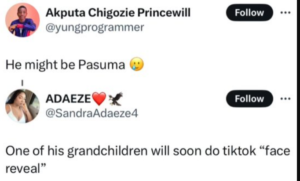
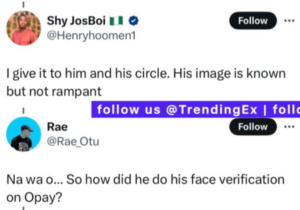
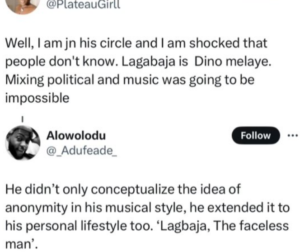
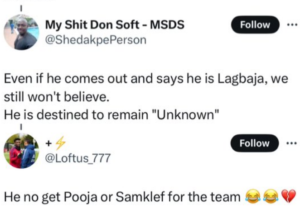
Lagbaja is currently making waves as Nigerians pay tribute to his close-knit circle of friends, who have remained loyal in keeping his true identity a secret for nearly 49 years. The legendary Bisinuade Ologunde, known as “Lagbaja,” has carefully guarded his facial identity, a move he once explained was to ensure that the focus stays on his music and message, rather than on his physical appearance.
At 64 years old, Lagbaja is not just a musician but also a writer and producer. He is a self-taught instrumentalist, mastering the saxophone and percussion. His love affair with music began at the tender age of 10, when he would sneak around to watch people play the piano. However, it was the sight of a wealthy white child in his neighborhood playing a saxophone that ignited his deep passion for music.
In 1991, Lagbaja formed his first band, which included the talented Ego Iheanacho, who later became an integral part of the group. Together, they created iconic hits like “Konko Below,” “Nothing for You,” and “Far Away.” Though Ego eventually left to pursue her own career, their collaboration remains one of the highlights of Nigerian music.
ALSO READ: Fireboy DML Reveals Studio Session With Masked Legend Lagbaja: I Never Saw His Face
Many may not know that Lagbaja is a “soft activist,” using his platform to represent the everyday person. Initially, he didn’t wear a mask, but he eventually adopted it in the 90s to early 2000s after experimenting with two different styles. The first mask was dismissed as a masquerade stunt, while the second was seen as a wrestling or boxing gimmick. Finally, he settled on a cloth mask, realizing that it gave him the anonymity and freedom he desired as his fame grew.
Lagbaja’s name itself comes from the Yoruba word Temedu, meaning “anonymous.” He once expressed that using the mask made him feel more comfortable as an artist. He is also an alumnus of Obafemi Awolowo University in Ile-Ife, hailing from Osun State. Raised in a religious home, Lagbaja was part of the famous Baptist Children’s Choir in the 70s, and continued attending Emmanuel Baptist Church in Ilorin during his university years, where his father was a deacon.
Despite his public persona, Lagbaja has only appeared without his mask a handful of times—most notably at his father’s burial in 2012 and at his eldest daughter’s wedding in 2013. Both events had strict photo policies, especially at his daughter’s wedding, where cameras were strictly forbidden. Although rumors and photos of Lagbaja’s face have circulated over the years, the legend has neither confirmed nor denied them.
Lagbaja reportedly relocated with his family to New York years ago. Even in more recent collaborations, such as his track with YBNL’s Fireboy, titled Back n Forth, Lagbaja maintained his anonymity. Fireboy himself didn’t see the legend’s face throughout the recording and shooting process.
Music executive Dayo ‘D1’ Adeneye is among the select few who know Lagbaja’s true identity, but for the rest of us, Lagbaja’s presence remains a mystery. As many Nigerians reflect, they may have walked past the masked icon, unaware they were in the presence of a legend.